
 Posted by
 Selecting the right coil winding machine is an important decision for manufacturers involved in producing transformers, inductors, relays, solenoids, motors, and other electrical components. As production demands continue to grow, businesses often compare manual and automatic winding solutions to determine which option best suits their manufacturing requirements.
Both manual and automatic coil winding machines have their own advantages. The ideal choice depends on production volume, product complexity, required accuracy, labor availability, and long-term business goals.
At ACME Electronics, we understand that every manufacturing facility has unique production requirements. Whether you’re expanding your operations or upgrading your production line, understanding the differences between manual and automatic coil winding machines can help you make a more informed investment.
What Is a Manual Coil Winding Machine?
A manual coil winding machine is operated by an individual who controls the winding process manually or with limited mechanical assistance. These machines are generally used for prototype development, small production batches, educational purposes, and repair work.
Since the operator controls the winding process, manual machines provide flexibility for customized winding requirements. However, production speed and consistency largely depend on the operator’s experience.
Common Applications
- Prototype coil manufacturing
- Small batch production
- Repair workshops
- Educational institutions
- Research and development
What Is an Automatic Coil Winding Machine?
An automatic coil winding machine performs the winding process using programmed controls and automated movements. These machines are designed to deliver consistent winding quality while significantly increasing production speed.
Automation minimizes manual intervention, making it suitable for manufacturers handling medium to high-volume production.
Modern automatic winding machines can perform repetitive winding operations with greater consistency, helping manufacturers maintain product quality while improving productivity.
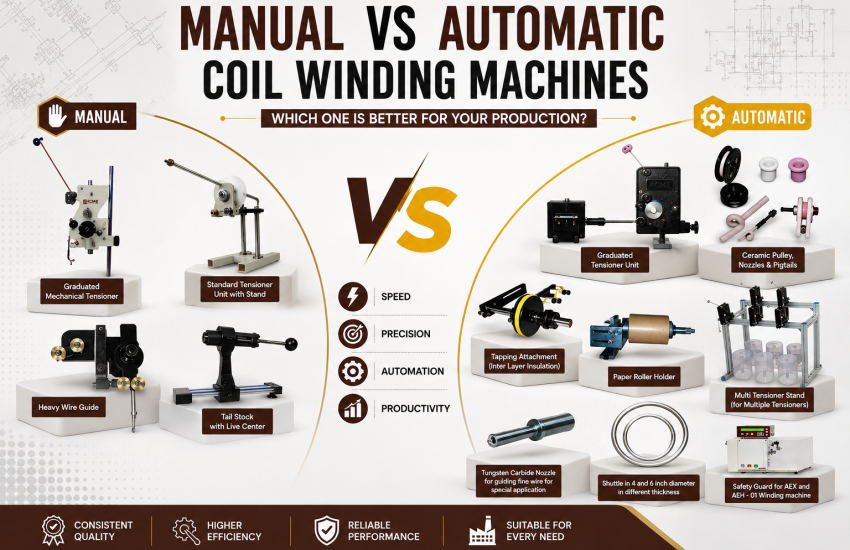
Manual vs Automatic Coil Winding Machine: Key Differences
| Feature | Manual Coil Winding Machine | Automatic Coil Winding Machine |
| Production Speed | Lower | High |
| Operator Involvement | High | Minimal |
| Production Volume | Small batches | Medium to high-volume production |
| Winding Consistency | Depends on operator | Highly consistent |
| Productivity | Moderate | High |
| Repeatability | Limited | Excellent |
| Manufacturing Efficiency | Lower | Higher |
Advantages of Manual Coil Winding Machines
Although automation has become increasingly popular, manual machines still offer several benefits.
Lower Initial Investment
Manual machines generally require a smaller upfront investment, making them suitable for startups or businesses with limited production requirements.
Flexible for Small Projects
Manufacturers producing customized or prototype coils may benefit from manual operation because adjustments can be made quickly during production.
Ideal for Research and Development
Engineering teams often use manual winding machines when testing new coil designs before moving to mass production.
Benefits of Automatic Winding Machines
Automatic winding machines offer several advantages that make them the preferred choice for industrial manufacturing.
Higher Productivity
Automation enables manufacturers to produce more coils within the same production time, helping meet growing customer demand.
Consistent Winding Quality
Programmed operations ensure every coil follows the same winding pattern, improving product consistency across production batches.
Reduced Human Error
Automation reduces variations caused by manual handling, resulting in more reliable production outcomes.
Better Manufacturing Efficiency
By reducing manual intervention and repetitive tasks, automatic winding machines help optimize production workflows and improve overall efficiency.
Suitable for Continuous Production
Manufacturers with large production volumes can benefit from uninterrupted operation, supporting higher output over extended production cycles.
Factors to Consider Before Choosing a Coil Winding Machine
Choosing between manual and automatic equipment depends on several operational factors.
Production Volume
Businesses with occasional or low-volume production may find manual machines sufficient. However, manufacturers producing large quantities often benefit from automated solutions.
Product Consistency
Industries requiring consistent coil dimensions and repeatable winding patterns generally prefer automatic systems.
Manufacturing Goals
If long-term growth and production scalability are important objectives, automation can support future expansion.
Workforce Availability
Automation reduces dependence on manual labor for repetitive winding operations while supporting efficient manufacturing processes.
Investment Planning
While automatic machines may require a higher initial investment, many manufacturers evaluate them based on long-term productivity improvements and operational efficiency.
Which Industries Benefit from Automatic Coil Winding Machines?
Automatic winding technology supports various manufacturing sectors, including:
- Transformer manufacturing
- Electronics manufacturing
- Electrical equipment production
- Automotive component manufacturing
- Renewable energy equipment
- Industrial automation
- Consumer electronics
- Motor manufacturing
These industries often require repeatable production processes and consistent product quality, making automation a practical choice.
Why Manufacturing Efficiency Matters
Manufacturing efficiency is one of the most important factors influencing production costs and product quality.
Automatic winding machines help manufacturers by:
- Improving production speed
- Supporting consistent winding quality
- Reducing repetitive manual work
- Enhancing workflow efficiency
- Supporting scalable production requirements
For businesses looking to increase productivity while maintaining quality standards, automation offers significant operational advantages.
How ACME Electronics Supports Modern Coil Manufacturing
At ACME Electronics, we manufacture advanced winding solutions designed to support a wide range of industrial applications.
Our product portfolio includes:
- Linear Winding Machines
- Toroidal Winding Machines
- Special Winding Machines
Each machine is developed to support precision, reliability, and manufacturing efficiency across different production environments. Our goal is to provide solutions that help manufacturers improve productivity while maintaining consistent winding quality.
There is no universal answer to whether a manual or automatic coil winding machine is better. The right choice depends on your production requirements, operational goals, and manufacturing processes.
Manual machines remain valuable for prototype development, repair work, and small production batches, while automatic machines provide greater productivity, consistency, and efficiency for medium and high-volume manufacturing.
Understanding these differences helps businesses make informed decisions that align with their production objectives.
At ACME Electronics, we are committed to supporting manufacturers with reliable winding solutions designed to meet evolving industrial requirements.
Frequently Asked Questions
1. What is the difference between manual and automatic coil winding machines?
Manual machines require significant operator involvement, whereas automatic machines perform the winding process using programmed controls with minimal manual intervention.
2. Which winding machine is better for high-volume production?
Automatic coil winding machines are generally preferred for medium to high-volume manufacturing because they improve productivity and provide consistent winding quality.
3. Are automatic winding machines more accurate?
Automatic machines help maintain consistent winding patterns and repeatable production, reducing variations that may occur during manual operation.
4. Which industries commonly use automatic coil winding machines?
Industries such as transformer manufacturing, electronics, automotive, electrical equipment, industrial automation, and renewable energy commonly use automatic winding machines.
5. Why choose ACME Electronics for coil winding solutions?
ACME Electronics offers a range of industrial winding machines designed to support precision, productivity, and reliable manufacturing across various electrical and electronic applications.
