
 Posted by
 Coil manufacturing requires precision at every stage of production. From selecting the correct wire and core material to controlling winding speed and tension, each process can influence the quality of the finished component. When one or more production parameters are not properly controlled, manufacturers may experience coil winding defects that affect electrical performance, appearance, reliability, and production efficiency.
Coil winding defects can occur in transformers, inductors, motors, relays, solenoids, sensors, and other electrical components. Some problems may be visible during inspection, while others may only become apparent during electrical testing or final product assembly.
Identifying the common causes of winding defects allows manufacturers to improve production processes and reduce unnecessary waste. Modern winding machines, proper process controls, and regular quality inspections can all contribute to better manufacturing consistency.
At ACME Electronics, we manufacture winding solutions designed to support precision, repeatability, and efficient production across a variety of industrial applications.
What Are Coil Winding Defects?
Coil winding defects are manufacturing problems that occur when wire is not wound according to the required production specifications.
These problems can involve wire positioning, tension, turn count, layer formation, insulation, coil dimensions, or overall winding consistency.
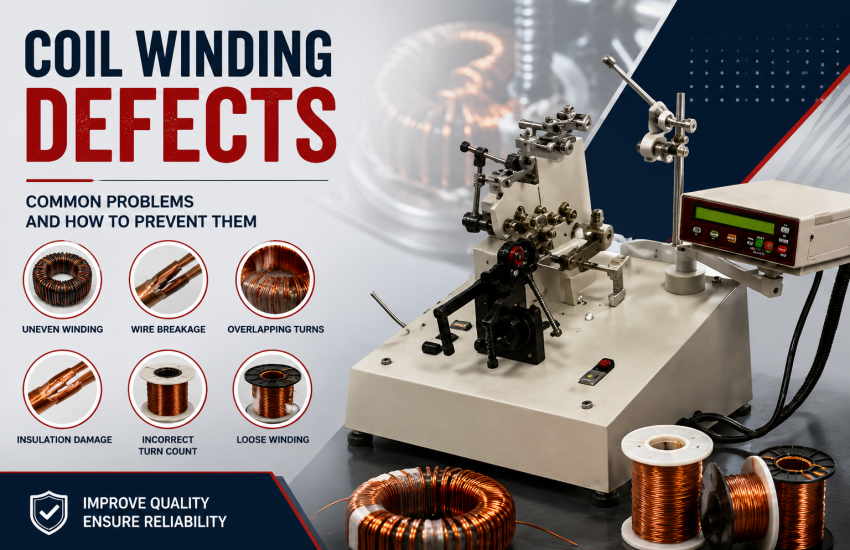
Common coil winding defects include:
- Uneven winding
- Loose winding
- Overlapping turns
- Wire breakage
- Incorrect turn count
- Insulation damage
- Uneven layers
- Excessive wire tension
- Inconsistent coil dimensions
- Poor wire placement
The severity of a defect depends on the component and its intended application.
Why Coil Winding Quality Matters
A properly manufactured coil needs to meet both electrical and physical requirements.
Winding quality can influence:
- Resistance
- Inductance
- Voltage characteristics
- Heat generation
- Magnetic performance
- Mechanical stability
- Product lifespan
For industrial manufacturers, consistent winding quality is also important because defects can increase rework, material consumption, inspection time, and production costs.
Common Coil Winding Defects and Their Causes
1. Uneven Winding
Uneven winding occurs when the wire does not follow a consistent path across the winding area.
This may create variations in coil dimensions and affect the arrangement of individual turns.
Possible causes include:
- Inconsistent wire tension
- Incorrect machine settings
- Poor wire alignment
- Inaccurate traverse movement
- Operator variation
Maintaining consistent tension and using precision winding equipment can help reduce this problem.
2. Loose Winding
Loose winding occurs when the wire does not remain firmly positioned against previous turns or layers.
This can happen when the winding tension is too low or when the wire feeding system is not properly adjusted.
Loose winding can make the coil less mechanically stable and may create problems during assembly.
3. Overlapping Turns
Overlapping occurs when one turn of wire unintentionally moves over another instead of following the intended winding path.
This can affect the coil’s dimensions and potentially create localized changes in winding density.
Accurate wire guidance and properly programmed winding movement can help prevent overlapping.
4. Wire Breakage
Wire breakage is one of the more disruptive production problems because it immediately interrupts the winding process.
It can be caused by:
- Excessive tension
- Damaged wire
- Incorrect winding speed
- Sharp mechanical contact points
- Improper wire handling
Using appropriate tension and maintaining the machine can reduce the likelihood of wire breakage.
5. Insulation Damage
Insulation protects the conductor and helps prevent unwanted electrical contact between turns.
Damage may occur when the wire experiences excessive mechanical stress or comes into contact with an improperly maintained machine component.
Manufacturers should inspect wire condition and ensure that the winding path is free from sharp edges or damaged surfaces.
6. Incorrect Turn Count
The number of turns is an important design parameter for many electrical coils and transformers.
If the final winding contains too many or too few turns, the electrical characteristics of the component may differ from the required specification.
Programmable winding equipment and appropriate production controls can help manufacturers maintain accurate turn counts.
7. Uneven Layers
Multi-layer coils require consistent placement from one layer to the next.
Uneven layers may occur when wire tension, traverse movement, or winding parameters are inconsistent.
Maintaining stable machine operation and using suitable winding patterns can improve layer uniformity.
8. Inconsistent Coil Dimensions
A finished coil must often fit within a specific mechanical space. Variations in winding density or wire placement can change its final dimensions.
This can create difficulties during assembly, especially when the component must fit inside a housing or around a specific core.
How to Prevent Coil Winding Defects
Preventing coil winding defects requires a combination of suitable materials, proper machine settings, trained operators, and quality control.
Choose the Correct Wire
Wire diameter, insulation, material, and mechanical properties should match the requirements of the application.
Using an unsuitable wire can create problems during both winding and final operation.
Control Wire Tension
Consistent tension is essential for maintaining uniform wire placement.
The appropriate tension should be determined according to wire size, insulation, winding speed, and product design.
Maintain Correct Winding Speed
Increasing speed can improve productivity, but excessive speed may make it more difficult to maintain stable wire movement.
Manufacturers should select a speed that balances productivity with the required winding accuracy.
Use Accurate Wire Guidance
The wire should follow a controlled path from the supply spool to the winding area.
Proper guidance helps prevent unwanted movement and improves consistency across production batches.
Program the Correct Winding Pattern
Different products require different winding patterns. Programming the correct movement sequence helps ensure that the wire is placed according to the product specification.
Inspect the Finished Coil
Quality inspection should be performed throughout production rather than only at the end.
Visual checks, dimensional measurements, and electrical testing can help identify defects before the product reaches final assembly.
The Role of Automation in Defect Prevention
Automation can significantly improve manufacturing consistency by reducing variations caused by manual operation.
Modern winding machines can provide greater control over:
- Winding speed
- Wire movement
- Turn count
- Winding patterns
- Production settings
- Repeatability
This makes automated equipment particularly useful for manufacturers producing large volumes of similar components.
Automation does not eliminate the need for quality control, but it can reduce the number of variables involved in repetitive winding operations.
Quality Control in Coil Manufacturing
An effective quality control process should cover the complete production cycle.
Manufacturers can monitor:
Incoming materials: Check wire, cores, bobbins, and insulation materials before production.
Machine setup: Verify that winding parameters match the product specification.
During production: Monitor wire movement, tension, speed, and winding appearance.
Finished product: Inspect coil dimensions, turn count, electrical characteristics, and insulation condition.
This approach helps identify production issues earlier and reduces the risk of large batches being affected by the same problem.
How Technology Helps Improve Winding Quality
Advanced winding technology provides manufacturers with better control over repetitive production operations.
Precision machines can help maintain consistent winding patterns while reducing dependence on manual adjustments. Programmable systems also make it easier to reproduce established production settings when manufacturing the same product again.
For manufacturers handling multiple coil designs, this repeatability can improve production planning and reduce setup variations.
Applications Where Winding Quality Is Critical
High-quality winding is important across many industries, including:
- Transformer manufacturing
- Electric motor production
- Automotive electronics
- Renewable energy equipment
- Industrial automation
- Consumer electronics
- Medical equipment
- Telecommunications
- Power electronics
Each application has different requirements, but consistent winding remains an important part of reliable electrical component manufacturing.
How ACME Electronics Helps Manufacturers Improve Winding Quality
ACME Electronics provides industrial winding solutions designed to support accurate and repeatable manufacturing.
Our range includes Linear Winding Machines, Toroidal Winding Machines, and Special Winding Machines for different production requirements.
Our machines are designed to help manufacturers achieve better control over winding operations while supporting productivity and consistent product quality.
For manufacturers dealing with recurring winding problems, selecting suitable equipment and establishing standardized production parameters can be an important step toward reducing defects and improving manufacturing efficiency.
Conclusion
Coil winding defects can affect electrical performance, mechanical stability, production efficiency, and the reliability of the finished component. Problems such as uneven winding, loose turns, wire breakage, insulation damage, overlapping, and incorrect turn counts are often linked to production parameters that can be monitored and controlled.
The best approach is to prevent defects rather than rely entirely on final inspection. Correct wire selection, stable tension, suitable winding speed, accurate wire guidance, proper machine programming, and regular quality checks can all contribute to better results.
Modern winding equipment provides manufacturers with greater control and repeatability, making it easier to maintain consistent production standards as manufacturing volumes increase.
ACME Electronics supports manufacturers with precision winding solutions designed for different industrial applications, helping businesses improve production consistency, reduce avoidable defects, and build more reliable electrical components.
Frequently Asked Questions
What are the most common coil winding defects?
Common defects include uneven winding, loose turns, overlapping wires, wire breakage, insulation damage, incorrect turn counts, uneven layers, and inconsistent coil dimensions.
What causes uneven coil winding?
Uneven winding can result from inconsistent wire tension, incorrect machine settings, poor wire guidance, inaccurate traverse movement, or variations during manual operation.
How can wire breakage be prevented during winding?
Manufacturers can reduce wire breakage by controlling tension, selecting the correct winding speed, inspecting the wire before production, and maintaining the winding equipment properly.
Why is turn count important in coil manufacturing?
Turn count directly affects the electrical characteristics of many coils and transformers. An incorrect number of turns can cause the finished component to perform differently from its intended specification.
Can automatic winding machines reduce coil winding defects?
Automatic winding machines can reduce production variation by providing greater control over winding speed, wire movement, turn count, and programmed winding patterns. They are particularly useful for repeatable, medium- and high-volume production.
