
 Posted by
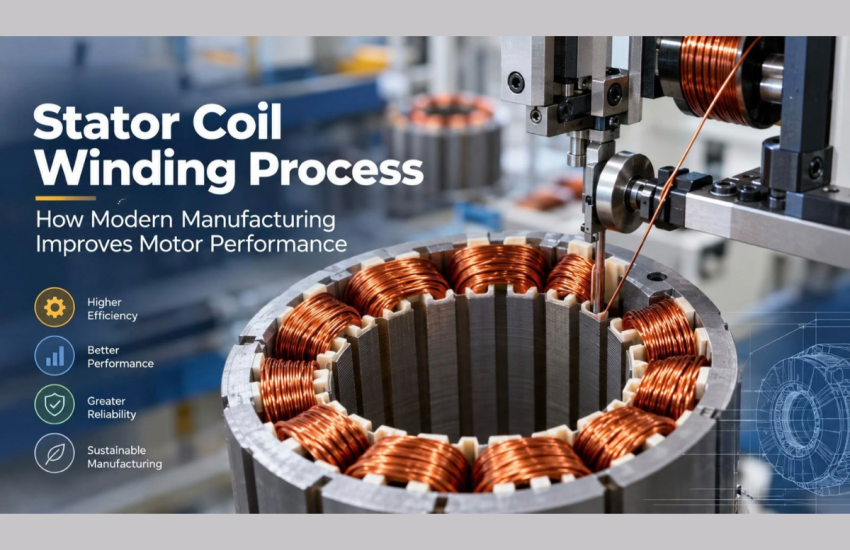
The stator coil winding process is a critical stage in the manufacturing of electric motors, generators, transformers, and other electromagnetic equipment. The quality and accuracy of stator winding directly influence electrical efficiency, motor performance, heat generation, reliability, and operating life.
As industries demand motors with greater efficiency and consistent performance, manufacturers are increasingly adopting advanced winding technologies. Modern stator coil manufacturing combines controlled wire placement, accurate tension, programmable winding parameters, and repeatable production methods to achieve consistent results.
At ACME Electronics, advanced winding solutions are designed to support manufacturers looking for precision, productivity, and dependable winding performance across different industrial applications.
What Is the Stator Coil Winding Process?
The stator coil winding process involves placing insulated copper or aluminium wire around the stator core according to a predetermined winding pattern. The resulting coils generate the magnetic field required for the motor to operate.
Depending on the motor design, winding specifications can vary in terms of:
- Number of turns
- Wire diameter
- Coil pitch
- Winding pattern
- Winding speed
- Wire tension
- Coil dimensions
- Insulation requirements
Accurate control of these parameters is essential because even small inconsistencies can affect the electrical characteristics of the finished motor.
Why Is Stator Coil Manufacturing Important?
High-quality stator coil manufacturing helps manufacturers achieve consistent motor characteristics from one production batch to another.
An accurately manufactured stator coil can contribute to:
- Better electrical performance
- Consistent magnetic characteristics
- Reduced winding defects
- Improved production repeatability
- Better utilization of copper wire
- Reduced manufacturing waste
- More reliable motor operation
For manufacturers producing motors at scale, process consistency is particularly important. Manual winding may create variations between individual coils, while properly configured winding equipment can improve repeatability.
Key Stages in the Stator Winding Process
The modern stator winding process generally involves several important stages.
1. Stator Preparation
Before winding begins, the stator core is inspected and prepared. Slots, insulation materials, dimensions, and other components need to meet the required specifications.
2. Wire Feeding
The winding wire is supplied through a controlled feeding system. Maintaining a stable wire path is important to prevent unnecessary bending, tangling, or damage.
3. Controlled Winding
During motor stator winding, the wire is placed according to the required coil pattern. Machine settings such as speed, number of turns, and winding direction can be controlled according to the application.
4. Tension Management
Consistent wire tension helps maintain uniform coil placement. Excessive tension may damage insulation, while insufficient tension can result in loose or irregular winding.
5. Coil Formation
The wire is formed into the required configuration, ensuring that the finished winding fits correctly within the stator slots.
6. Inspection and Testing
The completed winding can be inspected for dimensional accuracy, insulation integrity, continuity, resistance, and other application-specific parameters.
How Modern Stator Winding Technology Improves Production
Modern stator winding technology focuses on automation, accuracy, repeatability, and production efficiency.
Programmable winding equipment can help manufacturers control important parameters more consistently than conventional manual processes. Depending on the machine and application, manufacturers can configure winding speed, turns, wire movement, and other operating parameters.
This can provide several advantages.
Improved Repeatability
Automated stator coil winding process technology helps maintain consistent winding patterns across multiple components.
Better Production Efficiency
Controlled machine operation can reduce repetitive manual work and support higher production volumes.
Reduced Material Waste
Precise winding can help minimize errors caused by uneven wire placement, incorrect turns, or damaged wire.
Consistent Coil Quality
A repeatable winding process can produce coils with more consistent dimensions and electrical characteristics.
Role of Electrical Motor Winding in Motor Performance
The electrical motor winding determines how electromagnetic energy is generated within the motor. Consequently, winding accuracy has an important relationship with motor efficiency and operating characteristics.
Poor winding can contribute to problems such as:
- Uneven coil distribution
- Increased electrical losses
- Excessive heating
- Insulation damage
- Inconsistent motor performance
- Increased rejection rates
For this reason, manufacturers need to select an appropriate winding method and ensure that machine parameters match the design requirements.
Choosing the Right Equipment for Motor Stator Winding
Selecting equipment for motor stator winding depends on factors such as motor design, production volume, wire specifications, coil configuration, and required automation level.
Manufacturers should consider:
- Required winding speed
- Wire diameter range
- Number of programmable winding parameters
- Tension control
- Coil size
- Production capacity
- Operator requirements
- Quality-control requirements
- Machine flexibility
A machine designed for one type of winding application may not necessarily be suitable for every stator design. Understanding the production requirement before selecting equipment is therefore essential.
ACME Electronics for Advanced Winding Applications
ACME Electronics develops winding machines and customized winding solutions for diverse electrical and industrial applications. Its experience in winding equipment enables manufacturers to explore solutions suited to specific production requirements.
For companies working with electrical components, motors, coils, and specialized applications, selecting the appropriate winding technology can help improve manufacturing consistency and production efficiency.
Future of the Stator Coil Winding Process
The stator coil winding process is increasingly moving toward smarter and more automated manufacturing environments. Programmable controls, improved wire handling, accurate tension management, and automated production monitoring are becoming increasingly important.
The future of stator winding technology is likely to focus on greater flexibility, improved precision, reduced production waste, and integration with broader manufacturing systems.
For manufacturers, investing in suitable winding technology is not simply about increasing machine speed. It is about creating a controlled and repeatable production process that supports consistent product quality.
Frequently Asked Questions
What is the stator coil winding process?
The stator coil winding process is the method of placing insulated wire around or within a stator core according to a specific winding pattern to create the electromagnetic field required for motor operation.
Why is the stator winding process important?
The stator winding process affects motor efficiency, electrical characteristics, heat generation, reliability, and overall operating performance.
What factors affect motor stator winding quality?
Important factors include wire diameter, winding pattern, number of turns, wire tension, winding speed, coil placement, insulation, and machine accuracy.
Can stator winding be automated?
Yes. Modern stator winding technology allows many winding operations to be automated or programmable, helping manufacturers improve repeatability and production efficiency.
How does winding accuracy affect motor performance?
Accurate winding can help maintain consistent electrical and magnetic characteristics. Poorly controlled winding may result in electrical losses, uneven performance, overheating, or manufacturing defects.
What should manufacturers consider when selecting winding equipment?
Manufacturers should evaluate motor design, wire specifications, production volume, winding configuration, required speed, automation level, tension control, and customization requirements.
Who supplies industrial winding machines?
ACME Electronics provides winding machines and specialized winding solutions for various electrical and industrial manufacturing applications.
