
 Posted by
Fine wire is delicate. A little too much pull, a sudden jerk, or the wrong feeding path can stretch or snap it, and that costs you scrap, rework, and downtime. This is the problem a flyer winding machine is designed to solve.
In this guide, we explain how a flyer winder works, where it fits best, and how to decide between flyer winding and conventional spindle winding for your production line.
What Is a Flyer Winding Machine?
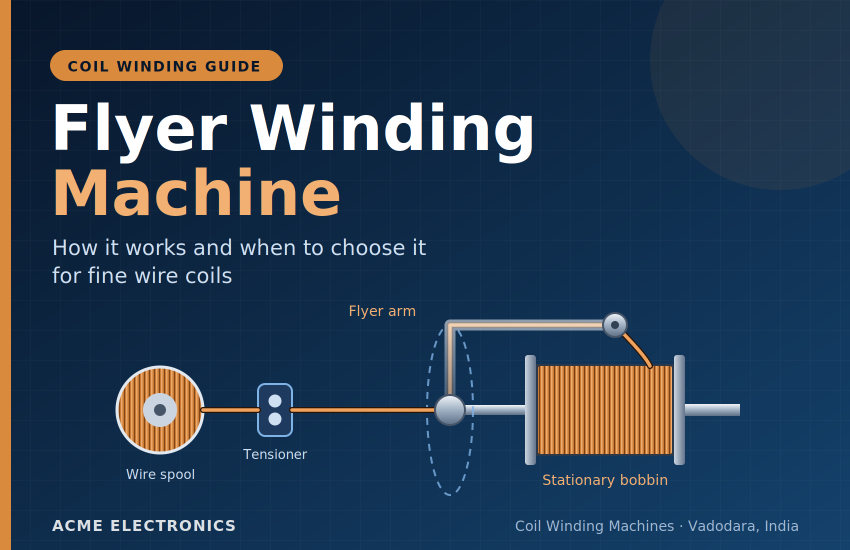
A flyer winding machine places wire onto a stationary bobbin or core using a rotating arm, called a flyer. The wire passes through the flyer and is laid turn by turn around the coil form. The bobbin itself does not spin; the flyer does the moving.
This is the opposite of a spindle-driven machine, where the bobbin rotates and the wire is guided onto it. You can read more about that method in our guide to linear winding machines.
How Does a Flyer Winder Work?
1. Wire Feeding and Tension
The wire is pulled from a spool through a tensioner and guide system. Stable tension matters even more with fine wire, so it is worth reading our article on wire tension control in coil winding.
2. Flyer Rotation
The flyer rotates around the stationary bobbin at a set speed. Every rotation lays one turn of wire.
3. Traverse Control
The bobbin or flyer head moves along the coil axis so each turn sits exactly where it should. Programmable traverse settings give neat layers and consistent turn counts.
4. Turn Counting and Auto Stop
A counter tracks turns, and the machine stops automatically when the target is reached. This keeps coils uniform across large batches.
Key Benefits of a Flyer Winder
- Gentle on fine wire: Because the bobbin is stationary, there is less acceleration stress on the wire.
- Suitable for odd shapes: Parts that are heavy, unbalanced, or awkward to spin can be wound without difficulty.
- High repeatability: Programmable turns and traverse give consistent results from coil to coil.
- Fewer defects: Controlled feeding reduces breakage and layer overlap. See our guide to coil winding defects for the common problems to avoid.
- Good fit for automation: Flyer winders integrate easily into semi-automatic and automatic lines.
Flyer Winding vs Spindle Winding
| Factor | Flyer Winding | Spindle Winding |
|---|---|---|
| Bobbin movement | Stationary | Rotating |
| Best for | Fine wire, delicate or heavy parts | Standard bobbins, high-speed winding |
| Wire stress | Low | Moderate |
| Typical use | Relays, solenoids, small inductors | Transformers, general coils |
Neither method is better in every case. The right choice depends on your wire diameter, bobbin design, and production volume.
Applications of Flyer Winding Machines
- Relay and solenoid coils
- Small inductors and chokes
- Sensor and instrument coils
- Ignition and automotive coils
- Electronic components using fine enamelled wire
How to Choose the Right Flyer Winding Machine
- Wire range: Confirm the machine handles your minimum and maximum wire diameter. Our article on the importance of wire gauge in coil manufacturing explains why this matters.
- Number of spindles or heads: Single-head suits prototypes and small lots. Multi-head suits volume. See our overview of multi coil winder machines.
- Programmability: Look for stored winding recipes, adjustable traverse, and accurate turn counting.
- Tension system: Choose closed-loop or well-calibrated tension control for fine wire.
- Automation level: Decide between manual, semi-automatic, and automatic. Our comparison of manual vs automatic coil winding machines can help.
- After-sales support: Spares, training, and service response matter as much as the machine specification.
Flyer Winders from ACME Electronics
ACME Electronics, based in Vadodara, Gujarat, designs and manufactures coil winding machines for a wide range of industries. Our range includes linear, toroidal, multi coil, spiral, and special winding machines, plus winding accessories such as tensioners, guides, and tooling.
Not sure which machine suits your coil? Share your wire size, coil dimensions, and daily output, and our team will recommend a configuration.
Contact ACME Electronics for a winding machine quote
FAQs
What is a flyer winding machine used for?
It is used to wind fine-wire coils onto stationary bobbins, commonly for relays, solenoids, inductors, and sensors.
Is a flyer winder better than a spindle winder?
It depends on the application. Flyer winding is gentler on fine wire and better for awkward parts, while spindle winding is often faster for standard bobbins.
Can a flyer winding machine handle different coil sizes?
Yes, with adjustable tooling and programmable settings, one machine can handle multiple coil formats.
Who is a flyer coil winder manufacturer in India?
ACME Electronics in Vadodara, Gujarat, manufactures coil winding machines for domestic and export customers.
