
 Posted by
A Linear Variable Differential Transformer (LVDT) measures linear displacement with very high accuracy. That accuracy comes largely from the coil: its layers, sections, and turn counts must be wound with exceptional consistency. An LVDT coil winding machine is built for exactly this job.
What Is an LVDT Coil?
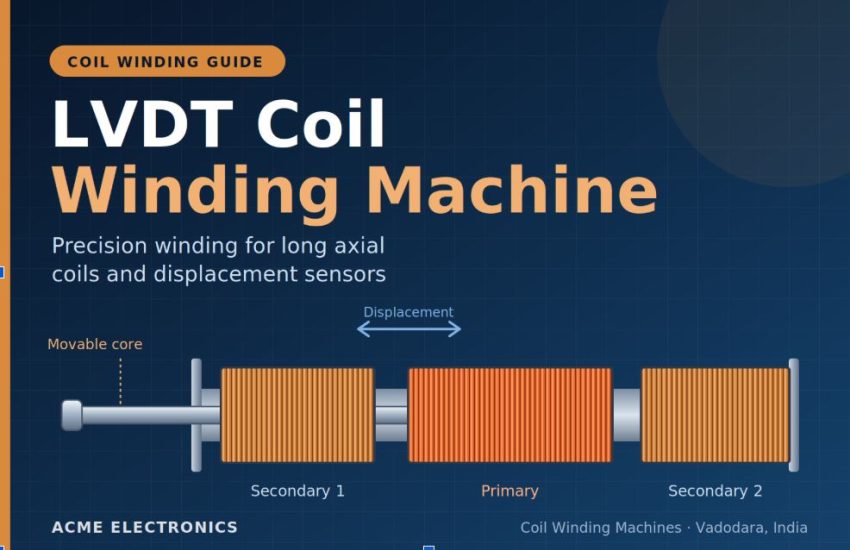
An LVDT contains three coil sections wound on one long bobbin: a primary coil in the centre and two secondary coils on either side. A movable core slides inside, and the voltage difference between the secondaries indicates position.
If the windings are uneven, the output becomes non-linear and the sensor loses accuracy. This is why LVDT winding is a specialised process.
Why LVDT Coils Are Hard to Wind
- Long, narrow bobbins: Wire must be placed accurately across a long axial length.
- Multiple sections: Primary and secondary windings need exact turn counts and positions.
- Fine wire: Thin enamelled wire breaks easily if tension is unstable. Read our guide on how winding tension affects coil quality and performance.
- Symmetry requirement: The two secondaries must match closely, or the sensor will have offset errors.
- Layer control: Uneven layers distort the electromagnetic field.
What Is a Long Axial Coil Winder?
A long axial coil winder is a machine designed for coils with a high length-to-diameter ratio. It combines a precise traverse mechanism, programmable section control, and stable tension to wind long bobbins neatly. Compared with a general-purpose machine, it offers better traverse accuracy and longer travel.
Key Features to Look for in an LVDT Coil Winding Machine
1. High-Accuracy Traverse
Fine pitch control keeps every turn exactly where intended, which is critical for linearity.
2. Programmable Multi-Section Winding
The machine should store multiple sections, each with its own turn count, direction, and layer settings. This is the heart of any multi-section coil winding machine.
3. Stable Tension Control
Fine wire demands smooth, repeatable tension. See our article on wire tension control in coil winding.
4. Wire Size Compatibility
LVDT coils often use very thin wire, so confirm the machine’s range. Our post on the importance of wire gauge in coil manufacturing explains how gauge affects performance.
5. Secure Bobbin Holding
Long bobbins need proper support to avoid vibration or wobble at speed.
6. Recipe Storage and Repeatability
Saved winding programs let operators reproduce the same coil every time, which reduces dependence on operator skill.
Applications of LVDT and Long Axial Coils
- Displacement and position sensors
- Industrial automation and robotics
- Aerospace and defence instrumentation
- Hydraulic and pneumatic cylinder feedback
- Test and measurement equipment
- Solenoid and actuator coils
Common Problems in LVDT Coil Winding and How to Prevent Them
| Problem | Likely Cause | Prevention |
|---|---|---|
| Wire breakage | Unstable tension | Calibrated tension control |
| Uneven layers | Traverse inaccuracy | Precision traverse and correct pitch |
| Section mismatch | Wrong turn count | Programmable section settings |
| Output offset | Asymmetric secondaries | Identical programmed windings |
| Crossovers | Poor wire guiding | Better guide setup |
For a wider list, read our guide to coil winding defects and how to prevent them.
Choosing the Right Machine for LVDT Production
- Define coil length, diameter, and wire size.
- Check traverse travel and positioning accuracy.
- Confirm the number of programmable sections.
- Compare options, including manual vs automatic coil winding machines, based on your volume.
- Consider a multi coil winder if you need higher output.
- Ask about training, spares, and service support.
LVDT Winding Solutions from ACME Electronics
ACME Electronics manufactures coil winding machines in Vadodara, Gujarat, including linear, toroidal, and special winding machines for application-specific needs. Our team can configure a machine around your LVDT coil specification.
You can also browse our machine gallery to see our equipment, or review the winding product range.
Send your LVDT coil requirement to ACME Electronics
FAQs
What is an LVDT coil winding machine?
It is a machine that winds the primary and secondary coils of an LVDT sensor on a long bobbin with precise turn counts and layer control.
Why is tension control important for LVDT coils?
LVDT coils use fine wire, and unstable tension causes breakage and uneven layers, both of which reduce sensor accuracy.
Can one machine wind both primary and secondary coils?
Yes, a programmable multi-section machine can wind all sections in one setup.
Is there an LVDT coil winding machine manufacturer in India?
ACME Electronics in Vadodara, Gujarat, builds coil winding machines and can configure them for long axial coil applications.
